TV Size Guide for Your Room: Find the Perfect Fit

Choosing the right TV size for your room is all about balancing viewing distance and screen resolution. For most living rooms, a TV between 55 and 65 inches offers an immersive experience without being overwhelming. Remember, a TV that’s too big can feel like you’re watching a movie in a movie theater, while one that’s too small can make you feel like you’re squinting.
It’s not just about the diagonal measurement, though. Your room’s dimensions and how you plan to use the TV play a big role. Consider whether you’re looking for a dedicated home theater feel or a more casual viewing setup. We found that understanding these factors helps you make a Understanding how to calculate your viewing distance is crucial for a comfortable viewing experience.smart purchase you’ll enjoy for years.
- General living rooms: 55-65 inches is a sweet spot.
- Consider room size for comfortable viewing.
- Higher resolutions allow for closer viewing distances.
- Think about your main use: movies, gaming, or casual TV.
Let’s walk through how to pick the perfect TV size for your specific space and viewing habits.
Choosing the Right TV Size for Your Space
Finding the perfect TV size is more art than science. It’s about creating a comfortable viewing experience. We’ve all been there, sitting too close or too far from the screen. Let’s figure out what works best for your living room.
Understanding Viewing Distance
Your seating distance from the TV is a primary factor. Think of it like sitting in a movie theater. If you’re too close, you miss the full picture. Too far, and the details become blurry. Research suggests a general rule for determining the ideal distance.
How Far Should You Sit?
For a 1080p HD TV, a good starting point is to multiply the screen’s diagonal size by 1.5 to 2.5. So, a 55-inch TV would mean sitting between 82.5 and 137.5 inches away. That’s about 7 to 11.5 feet.
Now, with 4K Ultra HD TVs, you can sit much closer. The pixels are so tiny they’re almost invisible. You can get closer and still enjoy a sharp image. For 4K, multiply the diagonal size by 1 to 1.5. For that same 55-inch 4K TV, you could sit between 55 and 82.5 inches away, or about 4.5 to 7 feet.
We found that many people naturally choose a viewing distance that falls within these recommended ranges. It just feels right. Don’t be afraid to test it out in your own home.
Room Size and TV Dimensions
Your room’s overall size matters. A huge TV in a tiny room can feel overwhelming. Conversely, a small TV might get lost in a large space. You want the TV to be a focal point, but not dominate everything.
Small Rooms (Under 100 sq ft)
For smaller rooms, like a cozy den or a bedroom, a TV in the 32- to 43-inch range is often ideal. A 40-inch TV is a popular choice. It offers a decent picture without making the room feel cramped. Remember those 4K guidelines; you can still sit fairly close.
Medium Rooms (100-250 sq ft)
This is where most living rooms fall. A TV between 50 and 65 inches is usually perfect. A 55-inch TV offers a great balance for typical living spaces. It’s big enough for an immersive experience but not so large that it takes over.
Large Rooms (Over 250 sq ft)
In spacious living areas or large entertainment rooms, you can go bigger. TVs from 70 inches up to 85 inches or even larger can work well. Just ensure your seating is positioned at an appropriate distance to take advantage of the larger screen.
Resolution and Viewing Distance
The resolution of your TV impacts how close you can comfortably sit. Higher resolutions mean more pixels on the screen. This results in a clearer, sharper image. Experts at the Society of Motion Picture and Television Engineers (SMPTE) suggest viewing angles that correlate with resolution.
HD vs. 4K vs. 8K
A standard HD TV (1080p) has about 2 million pixels. A 4K TV has four times that, around 8 million pixels. An 8K TV has a staggering 33 million pixels. The jump in pixel density means you can sit much closer to a 4K or 8K TV and still see a crisp image. You won’t notice individual pixels.
If you’re buying a new TV today, 4K is the standard. Most content is available in 4K. 8K is still quite niche, with limited content. For most people, 4K offers the best balance of quality and content availability (Cleveland Clinic).
Matching Your TV to Your Lifestyle
How you use your TV is just as important as the room it’s in. Are you a movie buff, a passionate gamer, or do you mostly catch up on the news?
For the Movie Lover
If you love that cinematic feel, you’ll want a larger screen. The goal is to fill more of your field of vision. For a dedicated home theater room, we’ve seen people opt for TVs 75 inches and up. In a standard living room, a 65-inch or 70-inch TV can provide that immersive movie night experience.
For the Avid Gamer
Gamers often prefer a slightly smaller screen than movie buffs, but with a focus on response time and refresh rate. You need to see quick actions clearly. For competitive gaming, a 55-inch or 65-inch screen is very popular. It allows you to see the action without straining your eyes. For competitive gaming, a 55-inch or 65-inch screen is very popular, offering a great balance for action.
Many gamers also prefer TVs with specific gaming features, like HDMI 2.1 support. This is essential for the latest consoles. We found that gamers prioritize a smooth, responsive picture above all else.
For Casual Viewers
If you mainly watch broadcast TV, news, or casual shows, you don’t necessarily need the largest screen. A 50-inch or 55-inch TV is often more than enough. The focus here is comfort and clarity for everyday viewing.
Putting It All Together: A Quick Checklist
Ready to make a decision? Here’s a quick rundown to help you choose:
- Measure your room: Know your space dimensions.
- Determine seating distance: How far will you sit?
- Consider resolution: Aim for 4K for modern viewing.
- Think about content: What will you watch most?
- Check the TV dimensions: Don’t forget the stand or wall mount depth.
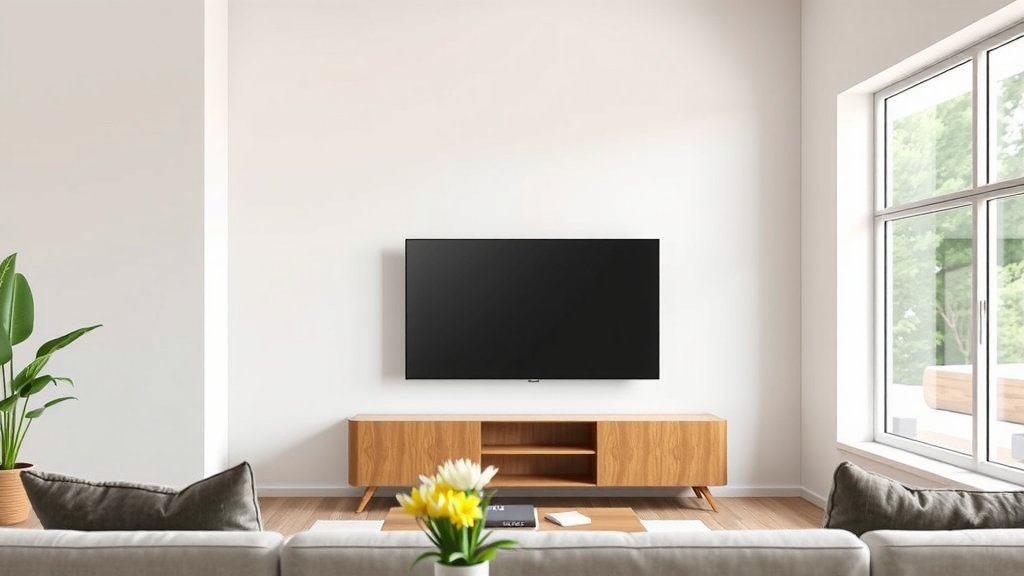
- Visualize it: Imagine the TV in your room.
By considering these factors, you can confidently select a TV size that enhances your viewing enjoyment without overwhelming your space.
Conclusion
You’ve learned that the perfect TV size is a personal choice. It balances your room’s dimensions, your preferred viewing distance, and how you plan to use the screen. Remember that 4K resolution allows you to sit closer for a more immersive experience. Whether you’re a movie buff or a casual viewer, we found that considering these factors leads to a TV that truly enhances your entertainment. Take your measurements, consider your space, and make a choice you’ll be happy with for years to come!
Frequently Asked Questions
Will a 75-inch TV fit in my living room?
To know for sure, measure your wall space and the TV’s dimensions, including any stand. You also need to check if your seating distance is appropriate for a screen that large. We recommend at least 6-7 feet for comfortable viewing of a 75-inch 4K TV.
Can I put a large TV in a small bedroom?
You can, but consider the viewing distance and how the TV will look when it’s off. A 50-inch or 55-inch TV is often a good compromise for smaller rooms. It provides an enjoyable picture without overwhelming the space.
Is it bad to sit too close to a 4K TV?
Generally, no. Higher 4K resolution means pixels are very small, so you can sit closer without seeing them. We found that sitting closer can actually increase immersion, especially for movies and gaming.
How do I measure my viewing distance?
Simply measure the distance from your primary seating position (like your couch) to where the TV screen will be. Use a tape measure for accuracy. This measurement is key to using the TV size guidelines effectively.
Does TV brand affect the best size for my room?
The brand itself doesn’t change the physics of viewing distance and room size. However, different brands might offer TVs in slightly different aspect ratios or with varying bezel sizes, which can affect the overall physical dimensions of the TV.