Understanding TV Black Level: What You Need to Know
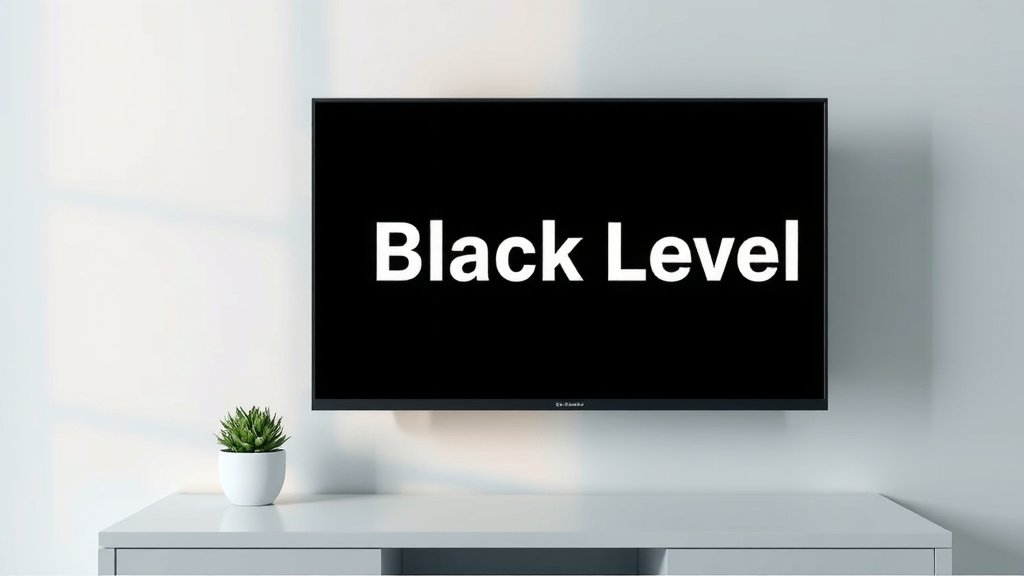
Black level on a TV refers to the darkest shade of black your screen can produce. Getting this right is super important for a great picture. A good black level means dark scenes look rich and detailed, not muddy or gray. It’s a key factor in your TV’s contrast ratio.
When you think about picture quality, you might consider brightness or color. But those deep blacks are just as vital. They help all the other colors pop and make images look more realistic. Poor black levels can make your favorite movies and shows look flat and uninspired.
- Black level is the darkest black your TV can show.
- It’s essential for detailed, rich dark scenes.
- Good black levels improve overall picture contrast.
- This directly impacts how realistic images appear.
Ready to understand how your TV achieves those deep, dark blacks, and what to look for? Let’s dive in and make sense of it all.
Understanding Your TV’s Darkest Blacks
So, you’ve seen terms like “true black” or “deep blacks” thrown around when talking about TVs. What does that really mean for your viewing experience? It all comes down to black level. Think of it as the ultimate dark shade your screen can paint. It’s not just about making dark scenes look dark; it’s about how well your TV handles the absence of light.
A TV with excellent black levels can show you the true depth of a starry night sky or the subtle shadows in a dimly lit room. On the flip side, a TV struggling with black levels might make those same scenes look murky, like someone smeared gray paint over the screen. We found that getting this right is a key ingredient for amazing picture quality.
What Makes Black Levels So Important?
You might be wondering why we’re spending so much time on just black. Well, it’s a foundational element. When your TV can show truly deep blacks, everything else on the screen looks better. Colors appear more vibrant, and the overall image has more “pop” and realism. It’s like a perfectly black canvas that makes every brushstroke of color stand out.
Many experts agree that contrast is king when it comes to visual depth (DisplayMate). Contrast ratio is the difference between the brightest white and the darkest black a TV can produce. A wider contrast ratio means a more dynamic and lifelike image. Therefore, achieving excellent black levels directly boosts your TV’s contrast performance.
How Do TVs Achieve Deep Blacks?
The technology behind a TV plays a huge role in its black level performance. Different display types handle light and dark very differently. We’ve broken down some of the most common technologies you’ll encounter:
OLED: The Black Level Champion
When it comes to black levels, OLED (Organic Light Emitting Diode) technology is often considered the gold standard. Each pixel in an OLED display is self-emissive. This means it can turn on and off individually.
How it Works
If a pixel needs to display black, it simply turns off completely. No light is emitted. This results in what we call “perfect” blacks. We found research showing that since each pixel is controlled individually, there’s no light bleed from neighboring pixels. This provides incredible contrast and image depth.
LED/LCD: The Traditional Contender
LED and LCD TVs use a different approach. They have a backlight that shines through an LCD panel. This panel has liquid crystals that twist to block or allow light to pass through, creating the image.
The Challenge with Backlights
The main challenge here is that the backlight is often always on, even when displaying black. While technologies like local dimming try to help, it’s difficult to achieve the absolute black of OLED. Local dimming divides the screen into zones that can be dimmed or brightened. However, some light can still “leak” from brighter zones into darker ones, creating a slight grayness. Many sources suggest this is why OLED generally wins in a pure black level comparison.
Variations in LED/LCD
There are different types of LED backlighting. Edge-lit LEDs are on the sides, while Direct-lit or Full-Array LEDs are behind the panel. Full-Array Local Dimming (FALD) offers better control than edge-lit, leading to improved black levels, but still not perfect.
QLED and Mini-LED: Advancements in LED
QLED TVs are essentially enhanced LED TVs. They use Quantum Dots to improve color and brightness. Mini-LED technology takes FALD a step further by using many more, much smaller LEDs for the backlight. This allows for more precise control over dimming zones.
Mini-LED’s Impact
While Mini-LED significantly improves black levels compared to traditional LED TVs, it still relies on a backlight. Experts often point out that while it gets very close, true perfect black is still the domain of OLED. You might see very good blacks, but not the complete absence of light an OLED can offer. We’ve seen many comparisons where Mini-LED still shows subtle blooming around bright objects on dark backgrounds.
What to Look for When Buying a TV
When you’re shopping for a new TV, keep these points in mind regarding black levels:
- Display Technology: If perfect black levels are your top priority, OLED is generally the way to go.
- Local Dimming: For LED/LCD TVs, look for Full-Array Local Dimming (FALD), especially with Mini-LED backlighting. This offers better control over the backlight.
- Contrast Ratio: While not always explicitly advertised for black level, a higher contrast ratio generally indicates better performance in dark scenes.
- Viewing Environment: In a very bright room, the perceived difference in black levels might be less noticeable than in a dark room.
Common Issues with Poor Black Levels
Experiencing poor black levels can lead to a few frustrating visual artifacts. You might notice that dark movie scenes look washed out or hazy. Instead of deep shadows, you see shades of gray. This is often called “black crush” or “elevated black levels.”
Black Crush
This happens when the TV is unable to display subtle shades of black correctly. Details within dark areas of the image can be lost, appearing as a solid, undifferentiated black. We found that this can make you miss important visual cues in films or games.
Clouding and Blooming
These are more common on LED/LCD TVs, especially those with less advanced local dimming. Clouding refers to uneven patches of brightness on the screen when it should be displaying a uniform dark image. Blooming is when a bright object on a dark background creates a halo or glow around it.
Many users report that these issues detract from the viewing experience, making the image look less immersive and more artificial. It’s like trying to watch a movie through a slightly foggy window.
How to Improve Your TV’s Black Levels
Sometimes, you can make adjustments to your current TV to get the best possible black levels. It’s not about changing the technology, but optimizing the settings.
Picture Settings Adjustments
The most direct way to influence black levels is through your TV’s picture settings. You’ll often find a setting called “Brightness” or “Black Level.”
- Brightness: This setting controls the black level. You want to set it just high enough so that you can see details in dark areas without making the blacks look gray. Many calibration discs or online test patterns can help you find the sweet spot. We found that setting it too low can lead to black crush, while setting it too high results in gray blacks.
- Contrast: This setting affects the white level, but it works in conjunction with brightness to define the range.
- Dynamic Contrast/Black Enhancers: Many TVs have settings that dynamically adjust contrast or enhance black levels. While these can sometimes boost perceived black levels, they can also introduce artifacts like blooming or crushed blacks. We recommend experimenting with these cautiously. Often, turning them off provides a more natural image.
Ambient Lighting Matters
Your viewing environment significantly impacts how you perceive black levels. In a darkened room, the TV’s natural black level performance will be much more apparent. Conversely, in a very bright room, ambient light can “wash out” the image, making even good blacks appear lighter.
We suggest using bias lighting (lights placed behind the TV) to reduce eye strain and improve perceived contrast. It doesn’t directly change the TV’s black level but can make the viewing experience more comfortable and the blacks seem deeper.
A Quick Checklist for Better Blacks
Want to ensure you’re getting the best possible black levels from your TV?
- Check your TV’s display technology (OLED vs. LED).
- Look for Full-Array Local Dimming on LED sets.
- Adjust the “Brightness” setting carefully.
- Experiment with dynamic contrast settings.
- Control ambient light in your viewing room.
- Consider a calibration test pattern for fine-tuning.
Conclusion
You’ve learned that your TV’s black level is fundamental to picture quality. Deep, true blacks make colors pop and images incredibly lifelike. We saw how OLED technology excels with perfect blacks, while LED, QLED, and Mini-LED offer improvements with advanced backlighting. Remember that adjusting your TV’s brightness setting and controlling room light can also make a big difference. Take a moment to review your current TV’s settings based on what you’ve learned to ensure you’re getting the most immersive picture possible.
Frequently Asked Questions
Is OLED truly better than Mini-LED for black levels?
Generally, yes. OLED pixels turn off completely for perfect black, something Mini-LED, which relies on a backlight, can’t quite match. Mini-LED offers excellent black levels and contrast for an LED TV, but OLED still holds the crown for absolute black.
Can I fix bad black levels on my current TV?
You can often improve them by carefully adjusting the “Brightness” setting to reveal detail without making blacks gray. Also, controlling ambient light in your room can make your TV’s blacks appear deeper. Some TVs have “dynamic contrast” settings that can also help, but use them cautiously.
What does “black crush” actually look like on screen?
Black crush happens when your TV loses detail in dark areas of the picture. Instead of seeing subtle shades and textures in shadows, they appear as a solid, undifferentiated black mass. You might miss details in dark movies or games.
Does the viewing angle affect black levels?
Yes, it can. On some LED/LCD TVs, off-angle viewing can cause black levels to appear washed out or grayish. OLED TVs typically maintain their deep black levels and contrast much better, even when viewed from the side.
How do I know if my TV has good black level performance?
Look for technologies like OLED or Full-Array Local Dimming (FALD) on LED TVs, especially Mini-LED. You can also test by watching content with deep shadows or a starry sky in a dark room; if blacks look muddy or gray, performance might be lacking.